When Customers Ask AI, Does Your Business Show Up?
The 2026 AI Visibility Report: how ChatGPT, Claude, Gemini and other AI assistants choose which businesses to recommend, and what you can (and can't) pay for.
By Aingel
AI is the new front door for customers
When customers ask ChatGPT, Claude or Gemini who to hire, they get a short list of names. The question for every business owner is simple: are you on it?
That habit is spreading fast. In BrightLocal's 2026 Local Consumer Review Survey, 45% of consumers had used ChatGPT or other AI tools for local business recommendations. A year earlier, it was 6%. AI is now the third most-used source of local recommendations, behind only Google and Facebook.
An AI answer isn't a page of ten blue links. It names a few businesses and explains why. If yours isn't named, there is no page two.
We reviewed the latest platform announcements and independent research, published through October 2026, to answer three questions. How do AI assistants decide who to recommend? What can you actually buy? And what moves the needle?
The short version
- AI is now a front door for customers. 45% of consumers have used AI tools for local business recommendations, up from 6% a year earlier.
- Each assistant reads the web differently. A strong Google ranking doesn't guarantee you'll be named by ChatGPT or Claude.
- Reputation drives recommendations. How often credible sources mention a business tracks AI visibility far more closely than backlinks do.
- You can buy ads in some AI assistants, but not the answer. ChatGPT and Google's AI search sell ads alongside the answer. Claude sells none.
- There is no "#1 in ChatGPT." AI answers change almost every time, so the goal is to be named consistently across many questions.
How AI assistants decide who to recommend
AI assistants recommend the businesses they can find, understand and trust across the web. Each assistant looks in different places.
They don't all search the same internet. For "best ___ near me" questions, assistants usually search the web in real time and summarize what they find. Google's AI leans on Google Search and Google Business Profiles. ChatGPT draws on other sources, including licensed data. In July 2026, Yelp agreed to license its reviews, photos and business details to OpenAI for use in ChatGPT. Claude uses a different search index altogether.
A Google ranking isn't enough. Ahrefs analyzed 15,000 prompts and found that, on average, only about 12% of the links AI assistants cited also ranked in Google's top 10 for the same prompt. You can win on Google and still be missing from AI answers.
Reputation outweighs links. In an Ahrefs study of 75,000 brands, mentions of a brand across the web correlated about three times more strongly with visibility in Google's AI Overviews than backlinks did. Reviews, local press, "best of" lists, community discussions and videos all shape what AI knows about you.
The answer changes almost every time. In a SparkToro and Gumshoe study, volunteers ran 12 recommendation prompts a combined 2,961 times. ChatGPT and Google's AI returned the same list of brands less than 1% of the time. What can be measured is how often you're named across many runs.
Real answers, captured Oct 29, 2026
- ChatGPTOct 29, 2026
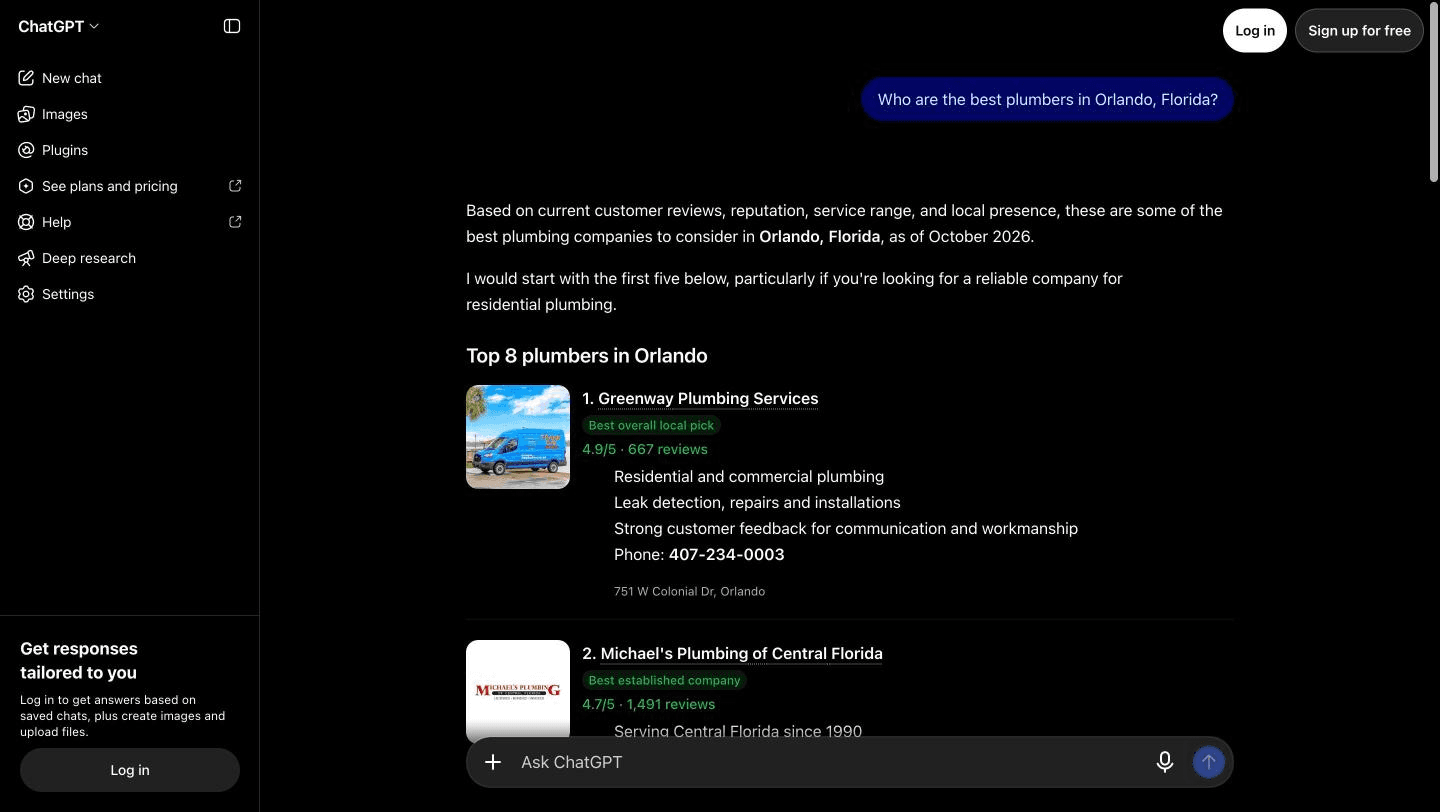
ChatGPT named eight companies and led with a different list than the other three. A second run an hour later changed the list again. - ClaudeOct 29, 2026
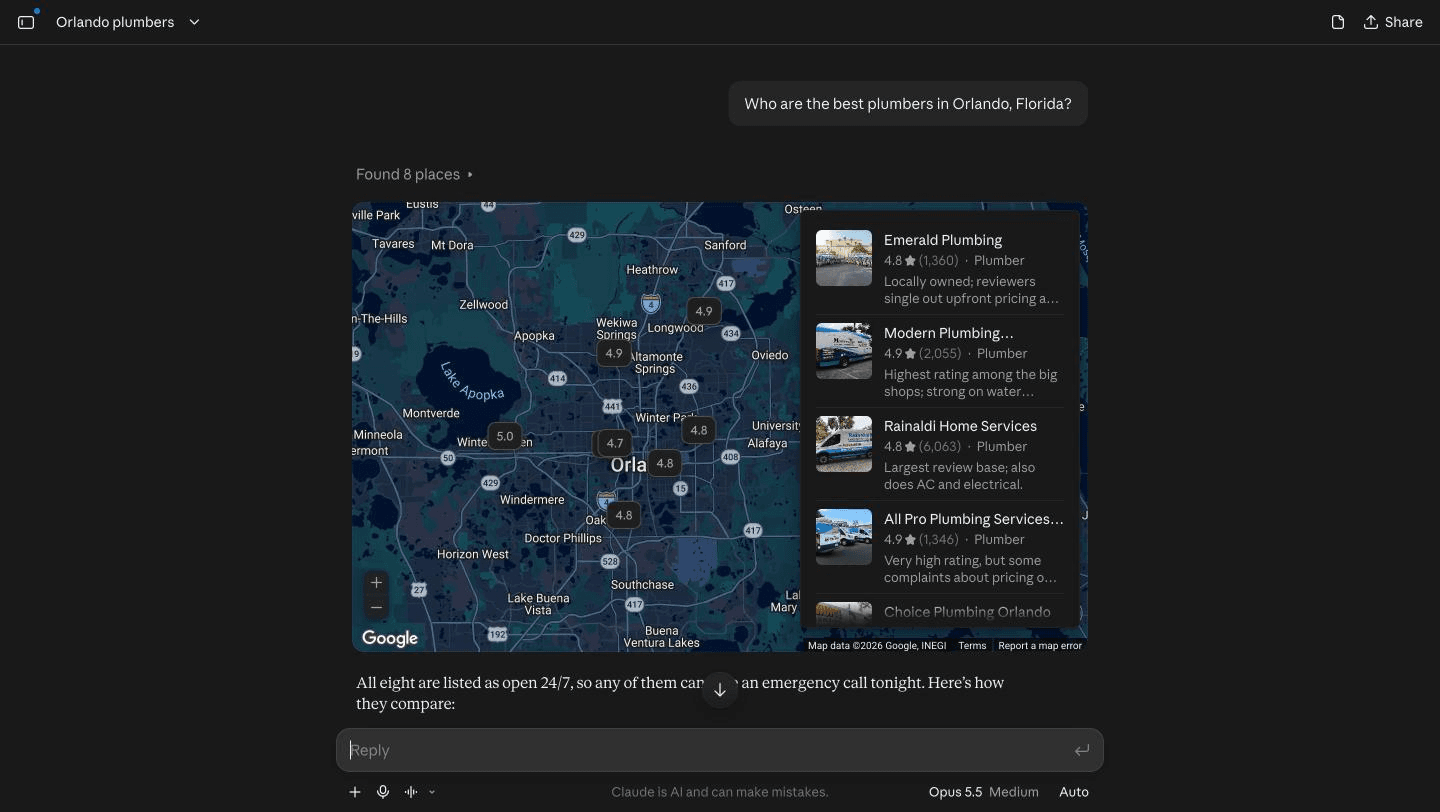
Claude pulled eight places from a map search and ranked them by rating and review count. None of its top four matched ChatGPT's. - GeminiOct 29, 2026
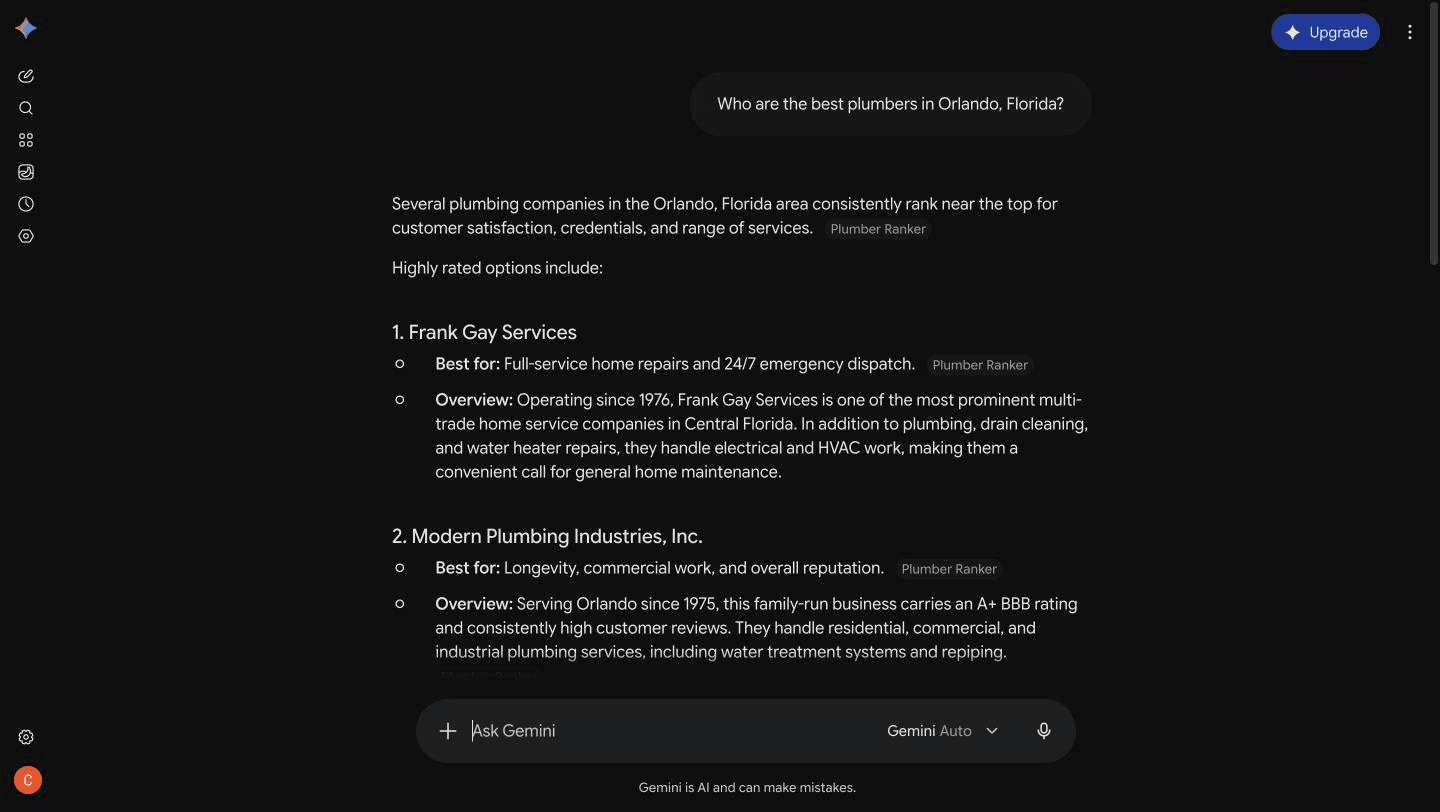
Gemini named two companies first and leaned on a third-party ranking site as its source. - PerplexityOct 29, 2026
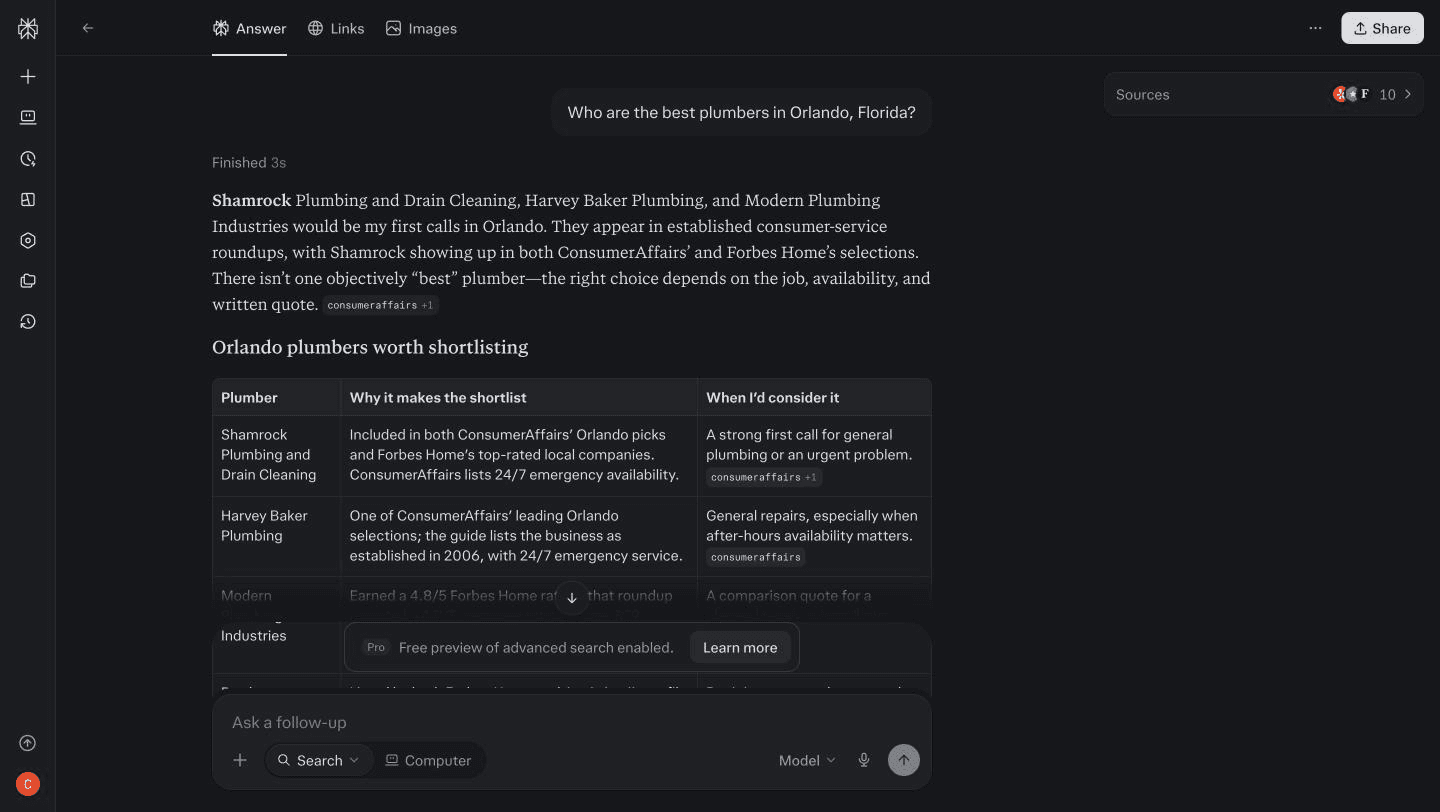
Perplexity shortlisted three companies drawn from consumer-review roundups, with citations on every line.
AI can get your business wrong. In the same study, AI tools even recommended businesses that no longer existed. Assistants can also repeat old hours, discontinued services or a previous address. Watching what AI says about you is now part of protecting your reputation.
Knowing which sources each assistant relies on, and which to fix first, is where most of the work lies. The answer differs by assistant, industry and market.
Paid vs. organic: what you can (and can't) buy
You can now buy ads in some AI assistants, but no platform sells a place inside the answer itself.
Where AI ads are sold (October 2026)
| Assistant | Ads for sale? | How it works |
|---|---|---|
| ChatGPT | Yes | Labeled ads appear below answers. OpenAI opened a self-serve Ads Manager to U.S. businesses in May 2026. |
| Google AI Overviews and AI Mode | Yes | Ads from Google Ads campaigns appear alongside AI answers in Search. |
| Microsoft Copilot | Yes | Labeled ads below Copilot answers, bought through Microsoft Advertising. |
| Gemini app | Not yet | No ads in the standalone app. In October 2026, Google said ads are coming to its AI agents. |
| Perplexity | No | Phased out its ads, citing user trust. |
| Claude | No | Anthropic has pledged to keep Claude ad-free. |
Ads sit below the answer, not in it
OpenAI says ads do not influence ChatGPT's answers and are always separate and labeled. Independent data shows how separate they are. When SE Ranking ran 50,006 commercial prompts, the advertiser was also cited in the answer above its own ad only 3.63% of the time. In Google's AI Mode, the figure was about 12%.
An ad buys you a spot next to the conversation, not a recommendation. A competitor can be the answer while you pay for the space below it.
Some industries face extra limits
ChatGPT restricts ads in regulated categories. Under OpenAI's ad policies, financial, health and legal advertisers face case-by-case approval or outright restrictions. For those businesses, organic visibility may be the only way into ChatGPT.
Paid vs. organic at a glance
| Comparison | Paid AI ads | Organic AI visibility |
|---|---|---|
| Where you appear | A labeled "Sponsored" spot below the answer | Inside the answer, named as a recommendation |
| Which assistants | ChatGPT, Google's AI search, Microsoft Copilot | All of them, including Claude, Perplexity and the Gemini app |
| Speed | Fast to launch | Builds over weeks and months |
| How you pay | Per impression or click, for as long as ads run | An investment in reputation and information that keeps working |
| How customers see it | As an ad | As a recommendation |
| When you stop paying | Visibility stops | Visibility largely stays |
Which do you need?
For most businesses, both, in the right order. Organic visibility is the foundation. It is the answer itself, the only way into ad-free assistants, and it keeps working when you stop spending.
Paid AI ads are the accelerator: fast, targeted and measurable while organic visibility builds. Running ads without that foundation can mean paying for the space below an answer that recommends your competitor.
Why it's worth acting now
AI sends fewer visitors than Google does, but those visitors convert well. Siege Media analyzed 78 websites using data from January to May 2026. Visitors referred by AI assistants converted at a median 1.26 times the rate of organic search visitors, and 1.29 times for consumer and local services.
AI is still a small channel, at roughly 0.2% to 3% of sessions on most of those sites. But a customer who asks an AI for a recommendation and gets your name often arrives ready to act.
The window is open now. The signals AI relies on, such as reviews, listings, press and community discussion, take months to build. Businesses that build them first become the default answer that competitors have to displace.
Six mistakes that keep businesses out of AI answers
All six are fixable.
- 1
Blocking AI without knowing it.
Some website security settings and hosting defaults stop AI assistants from reading your site.
- 2
Optimizing for Google alone.
Strong SEO helps, but AI assistants also draw on other search indexes, review platforms and licensed data.
- 3
Inconsistent business details.
Different hours, phone numbers or descriptions across directories confuse AI, and it may repeat the wrong one.
- 4
A thin or stale review profile.
Assistants lean on review platforms for local recommendations, so steady, recent reviews matter.
- 5
Buying shortcuts.
Fake reviews, disguised paid placements and hidden text aimed at AI can backfire. The FTC's 2024 rule on fake reviews carries civil penalties.
- 6
Measuring with screenshots.
One AI answer proves nothing when answers change almost every time. Visibility has to be measured across many runs.
How Aingel helps
Aingel runs AI advertising and AI visibility as one program, so the ads you buy and the answers you earn work together.
- 1
Diagnose.
We ask the major AI assistants the questions your customers actually ask: by your name, by service and by neighborhood. We run each question many times. You see how often you're recommended, which competitors are named instead and what AI gets wrong about you.
- 2
Build.
We score your business against our eight-part AI Visibility Framework. Then we fix what keeps assistants from finding, understanding and trusting you, from your website and listings to the reputation signals AI relies on.
- 3
Amplify.
Where it pays, we launch and manage AI ad campaigns on ChatGPT, Google's AI search and Microsoft Copilot. Every campaign is aligned with your organic strategy and each platform's rules.
- 4
Measure and improve.
Each month, you get a clear report: how often AI recommends you, your share of voice against competitors, the accuracy of what it says and the customers it sends. Then we adjust.
What we won't do: promise you "#1 in ChatGPT." No one can honestly guarantee a position in answers that change every time they're asked. We promise a clear baseline, a real plan and measurable progress.
Frequently asked questions
Can I pay to be recommended by ChatGPT?
No. You can buy ads that appear in a labeled spot below ChatGPT's answers, but OpenAI says ads don't influence the answers themselves. Being recommended takes organic visibility.
Does Claude have ads?
No. Anthropic has committed to keeping Claude ad-free. The only way to appear in Claude's answers is organically.
Is AI visibility the same as SEO?
They overlap, but they aren't the same. AI assistants draw on different search indexes, licensed data and third-party mentions. Strong Google rankings alone don't guarantee AI recommendations.
How long does it take to see results?
It depends on the assistant and the fix. Corrected listings and website details can show up once assistants pick them up. Reputation signals, such as reviews and press, build over months. Where your category is eligible, paid AI ads can start much sooner.
Can a small local business compete with big brands?
Yes. For local questions, AI leans heavily on listings, reviews and local sources. Those are signals a small business can directly improve.
Sources
- BrightLocal, Local Consumer Review Survey 2026, February 2026
- Ahrefs, Only 12% of AI Cited URLs Rank in Google's Top 10 for the Original Prompt, August 2025
- Ahrefs, An Analysis of AI Overview Brand Visibility Factors (75K Brands Studied), May 2025
- SparkToro, AIs are highly inconsistent when recommending brands or products, January 2026
- Axios, Yelp partners with ChatGPT to surface reviews, July 2026
- OpenAI, Our approach to advertising and expanding access to ChatGPT, January 2026
- Axios, OpenAI launches self-serve ad platform, May 2026
- OpenAI, Ad policies, accessed October 2026
- Google, New ad formats built with Gemini coming to Google Search, May 2026
- Stacker and WebFX, Inside Microsoft's Copilot search ads, February 2026
- Android Headlines, Google confirms its Gemini agent is coming to consumers, and so are ads, October 2026
- The Decoder, Perplexity pulls advertising from its search engine, February 2026
- The Register, Anthropic's no-ads pledge for Claude, February 2026
- Search Engine Land, Study: ChatGPT ads appear on 26% of commercial prompts, August 2026
- SE Ranking, AI Mode ads tracker and study, July 2026
- Siege Media, AI Traffic Conversion Rates: Are They Really 7x Better?, June 2026